
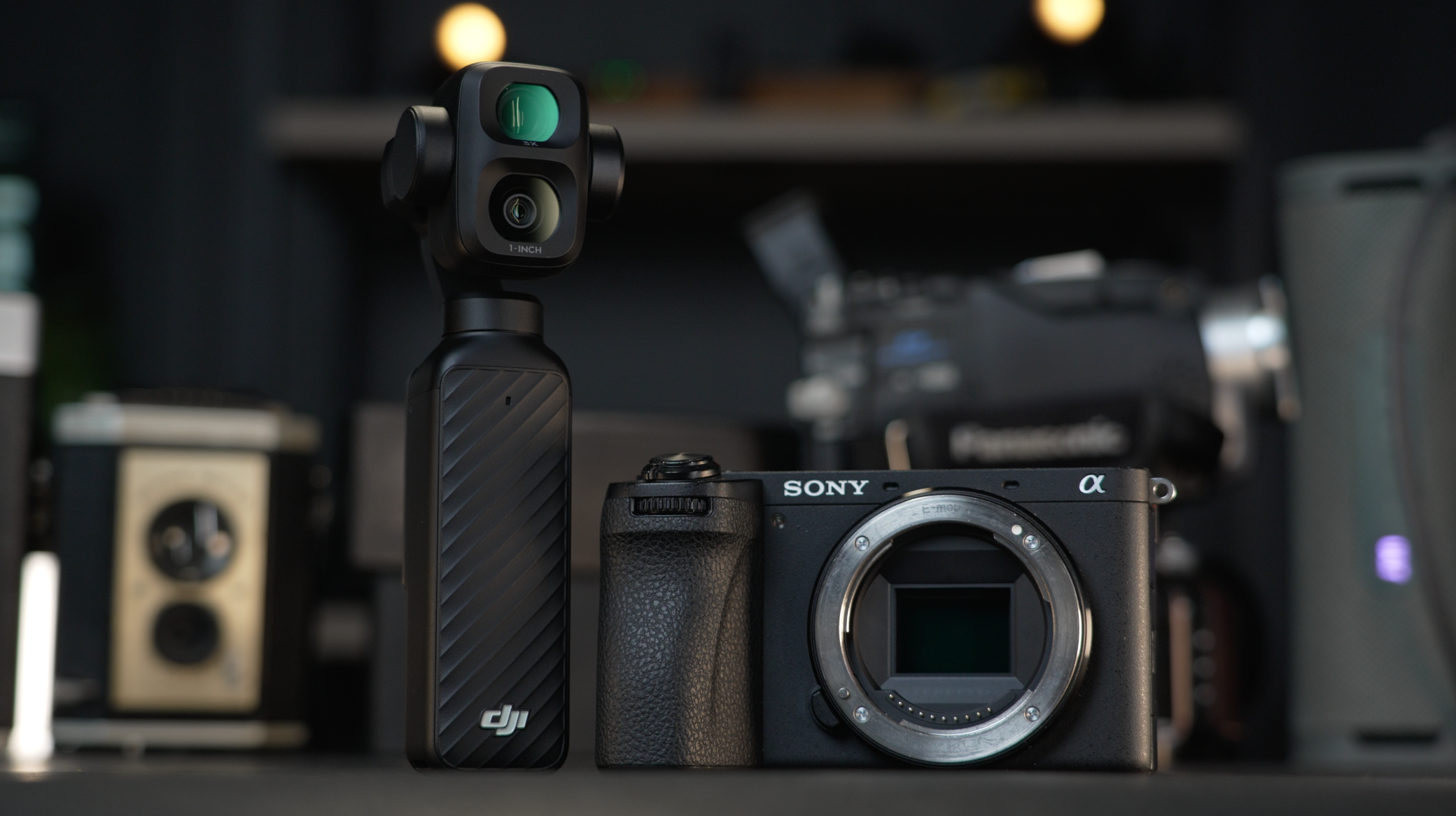
Can DJI’s Pocket 4P Beat Sony's a6700 - Camera Battle
Jul 24, 2026Get the full story watching the video above ⬆️
Purchase:
Sony a6700 - https://geni.us/3v1kTN
The Sony a6700 is the better overall camera system, but the Osmo Pocket 4P came much closer than I expected.
That surprised me because these cameras are built around completely different ideas. The Sony a6700 is an APS-C interchangeable-lens camera designed for serious photography and video. The Pocket 4P is a tiny dual-lens gimbal camera built around portability, stabilization, and convenience.
After using both cameras in daylight, low light, Log profiles, photography, moving shots, product shots, and controlled lighting, I found that the Pocket 4P can compete with the a6700 in more situations than its size would suggest.
However, the Sony still wins when I need maximum control over lenses, depth of field, monitoring, accessories, and the overall image.
Osmo Pocket 4P vs Sony a6700 Overview
The Pocket 4P uses two cameras.
Its main 1x camera has a 1-inch sensor and a 20mm-equivalent lens. Its 3x camera gives me a tighter 60mm-equivalent perspective. It can also record up to 4K at 240 frames per second and includes a built-in mechanical gimbal.
The Sony a6700 uses a much larger APS-C sensor and accepts interchangeable lenses. It can record up to 4K120 and gives me access to a huge range of lenses, focal lengths, apertures, and accessories.
The biggest difference is not simply sensor size.
The Sony a6700 is a complete camera system. The Pocket 4P is a compact creative tool designed to be easy to carry and fast to use.
Price
The Sony a6700 starts at approximately $1,498 for the body.
The Pocket 4P may sell for around $575 in some overseas markets, but it is not officially sold in the United States. Imported models can be difficult to find for under $1,000.
The Sony is more expensive once you add lenses, batteries, memory cards, and possibly a gimbal. However, the system is also far more expandable.
The Pocket 4P includes its lenses and stabilization in one small package.
For someone who wants a complete, ready-to-shoot setup without buying additional lenses or a gimbal, the Pocket 4P can offer strong value. The Sony makes more sense for someone who wants a camera system they can build around over time.
Lens Options
Lens flexibility is one of the biggest advantages of the Sony a6700.
The Pocket 4P limits me to its 20mm and 60mm-equivalent lenses. Those two perspectives cover a lot of everyday situations, but I cannot change the aperture or attach a completely different focal length.
With the Sony a6700, I can choose from wide-angle, portrait, macro, telephoto, and zoom lenses.
For this comparison, I used a Viltrox 13mm f/1.4 to create a field of view close to the Pocket 4P’s 1x camera. I also used the Sigma 18-50mm f/2.8 around 40mm to get closer to the Pocket 4P’s 3x framing.
The ability to change lenses gives the a6700 far more control over composition and visual style.
However, that flexibility comes with extra cost and weight.
Background Blur and Depth of Field
The Sony a6700 produces more natural background blur because of its larger sensor and interchangeable lenses.
With a fast lens such as the Viltrox 13mm f/1.4, I can create deeper separation between the subject and background.
The Pocket 4P still gives me attractive background blur, especially when using its tighter camera. The out-of-focus lights looked smooth and much better than what I usually expect from a phone or smaller compact camera.
The difference is that the Sony gives me control.
I can choose the lens, focal length, aperture, and distance from the subject. With the Pocket 4P, I am working within the look its built-in lenses provide.
For portraits, interviews, and cinematic talking heads, the a6700 has the advantage.
Image Quality and Color
The Pocket 4P consistently gave me more vibrant colors straight out of the camera.
The Sony a6700 often looked flatter and more muted.
That does not necessarily mean the Pocket 4P had better image quality. In many cases, the Sony retained more information in the shadows and gave me more room to shape the image in post-production.
In one indoor scene, the Pocket 4P had richer colors, but the couch in the foreground lost some darker detail.
The Sony’s colors looked less exciting initially, but I could see more information in the couch and darker areas of the room.
This pattern continued throughout my testing.
The Pocket 4P often looked more finished straight out of the camera. The Sony often gave me a more neutral starting point that could be customized later.
Standard Color Profiles
The Pocket 4P’s standard profile tends to produce stronger saturation and more pop.
That can be helpful for creators who do not want to color grade.
However, some outdoor foliage looked almost lime green, and certain subjects took on a slightly more digital appearance.
The a6700’s standard color looked more subdued, but that sometimes made the image feel more natural.
In a wildlife shot, the Sony’s larger sensor and more restrained color gave the scene a more traditional mirrorless-camera look.
Some people may prefer the Pocket 4P’s brighter and more colorful image. Others may prefer the a6700’s flatter, more realistic rendering.
This comes down partly to personal taste.
Dynamic Range
The Sony a6700 should have the advantage in dynamic range because of its larger sensor, but my standard-profile results were more complicated.
In one backlit exterior scene, I exposed both cameras for the sun. The Pocket 4P maintained more brightness in the building and more color in the sky.
The Sony produced more dramatic highlights and clouds, but the rest of the image became much darker.
This may come down to differences in each camera’s standard-profile tone curve rather than sensor size alone.
The Sony may preserve more total information, but its standard profile can render the midtones and shadows more conservatively.
The Pocket 4P appears to lift and saturate parts of the image to create a brighter result.
When shooting Log, the Sony’s larger sensor and deeper system flexibility become more important.
D-Log 2 vs S-Log3
The Pocket 4P records in D-Log 2, while the Sony a6700 records in S-Log3.
I was surprised by how closely the two profiles matched before grading. Their exposure and luma waveforms were extremely similar.
Once I began color grading, I noticed more differences.
The Pocket 4P accepted my LUT quickly, and I could get close to the look I wanted without many extra adjustments.
The Sony footage had a slight magenta tint, so I needed to reduce the saturation and make additional corrections.
That does not mean D-Log 2 is better than S-Log3 in every situation. The Sony gives me a much deeper professional workflow and more control overall.
However, D-Log 2 is extremely impressive for such a small camera.
Lock Your White Balance
One of the most important things I learned from comparing these cameras is to lock the white balance.
Automatic white balance can shift during a shot, especially in low light or when bright light sources enter the frame.
Even though white balance can be corrected in post-production, it is always easier to get it right in the camera.
This is particularly important when shooting Log because a strong color cast can make grading more difficult.
Low-Light Performance
The difference in low light was much smaller than I expected.
The Pocket 4P often produced more vibrant colors, while the Sony a6700 looked more muted.
In moving low-light shots, the Pocket 4P had a practical advantage because of its mechanical gimbal.
I could walk with it and maintain smooth movement without relying heavily on digital stabilization.
With the Sony a6700, Active Stabilization can make low-light footage look worse. For smooth moving shots, I would prefer putting the Sony on a gimbal.
When I examined noise, both cameras were closer than expected.
The Pocket 4P’s noise occasionally looked more digital and processed. The Sony’s grain looked slightly more natural.
Overall, I did not see a massive difference in basic low-light image quality. The Sony still has more potential with the right lens, but the Pocket 4P performs remarkably well for its size.
Stabilization
Stabilization is one area where the Pocket 4P clearly wins.
Its built-in mechanical gimbal gives me incredibly smooth walking footage without additional equipment.
The Sony a6700 has Active Stabilization, but it still looked much shakier in my moving tests.
Digital stabilization can also crop the image and introduce unwanted artifacts.
For similarly smooth footage from the Sony, I would normally use:
-
A stabilized lens
-
Digital stabilization
-
A handheld gimbal
-
A combination of these tools
The Pocket 4P gives me that smoothness immediately.
For travel, walking shots, low-angle movements, and quick cinematic B-roll, the Pocket 4P is much easier to use.
Green-Screen and Product Shots
Both cameras performed well in controlled studio lighting.
For an interior product shot, the results were very close.
However, I preferred the Sony a6700 for green-screen work because it handled darker colors more accurately.
The Pocket 4P introduced a slight magenta tint across the body of a retro camera.
The Sony maintained more neutral blacks and darker tones, which made it the better choice for pulling a clean key.
For professional studio and product work, the Sony offers more reliable control.
Photography
Both cameras can take good everyday photos, but the Sony a6700 is the more complete photography camera.
The Pocket 4P captures approximately 37-megapixel photos, while the a6700 uses a 26-megapixel APS-C sensor.
Megapixels do not tell the entire story.
The Pocket 4P gives me more resolution on paper, but I am limited to two fixed focal lengths and a very small display.
The Sony gives me:
-
Interchangeable lenses
-
A larger rear display
-
An electronic viewfinder
-
Better manual controls
-
More depth-of-field control
-
Easier focus confirmation
-
A more comfortable photography experience
For casual memory-type photography, I would have no problem using the Pocket 4P.
For serious photography, portraits, wildlife, events, or professional work, I would choose the Sony a6700.
Monitoring and Connectivity
The Sony a6700 has a major practical advantage when it comes to monitoring.
Its larger display makes it easier to check focus, exposure, playback, and composition.
It also includes an electronic viewfinder, which is extremely helpful when shooting photography in bright conditions.
The Pocket 4P’s display is much smaller.
It is usable, but reviewing focus and fine detail can be more difficult.
The Sony also provides ports and support for external accessories, making it easier to build a more professional production setup.
That includes options for external microphones, monitors, recorders, cages, and other equipment.
Ease of Use
The Pocket 4P is much easier to carry.
I can place it in a small bag or pocket and begin shooting almost immediately.
I do not need to choose a lens, balance a gimbal, or build a rig.
That simplicity is a huge advantage.
The Sony a6700 requires more preparation, but it also gives me more control.
The Pocket 4P is better when I want to move quickly and stay creative. The Sony is better when I want to carefully build the exact image I have in mind.
Who Should Buy the Osmo Pocket 4P?
The Pocket 4P is best for:
-
Travel creators
-
Vloggers
-
Solo filmmakers
-
Run-and-gun shooters
-
Creators who value stabilization
-
People who want a tiny camera
-
Anyone who frequently shoots moving B-roll
-
Creators who do not want to carry a gimbal
You may want to skip it if you need interchangeable lenses, professional ports, a large display, or an electronic viewfinder.
Who Should Buy the Sony a6700?
The Sony a6700 is best for:
-
Hybrid photo and video creators
-
Professional filmmakers
-
Portrait photographers
-
Product shooters
-
Talking-head creators
-
People who want interchangeable lenses
-
Creators who need external accessories
-
Anyone building a long-term camera system
You may want to skip it if portability and stabilization are your highest priorities.
The Sony setup can become larger, heavier, and more expensive once you add lenses and a gimbal.
Is the Pocket 4P Better Than the Sony a6700?
The Pocket 4P is better in portability, stabilization, convenience, and slow-motion frame rates.
The Sony a6700 is better in lens flexibility, photography, monitoring, depth of field, accessories, and overall system control.
The image-quality difference was much smaller than I expected.
In some scenes, the Pocket 4P looked more vibrant and immediately pleasing. In others, the Sony retained more natural shadow detail and gave me a more traditional mirrorless-camera image.
The Pocket 4P can absolutely compete, but it does not replace everything the Sony can do.
Final Verdict
I am giving the overall win to the Sony a6700 because it is the more complete camera system.
Being able to change lenses gives me far more control over focal length, background blur, composition, and the overall look of the image.
The Sony also gives me a larger display, an electronic viewfinder, external ports, better monitoring, and a much stronger photography experience.
However, the more I use the Osmo Pocket 4P, the more I keep thinking about how much I enjoy it.
It is smaller, easier to carry, incredibly smooth, and much closer to the Sony a6700 in image quality than I expected.
The Sony a6700 is the better all-around camera.
The Osmo Pocket 4P may still be the camera I actually bring with me more often.
Author