
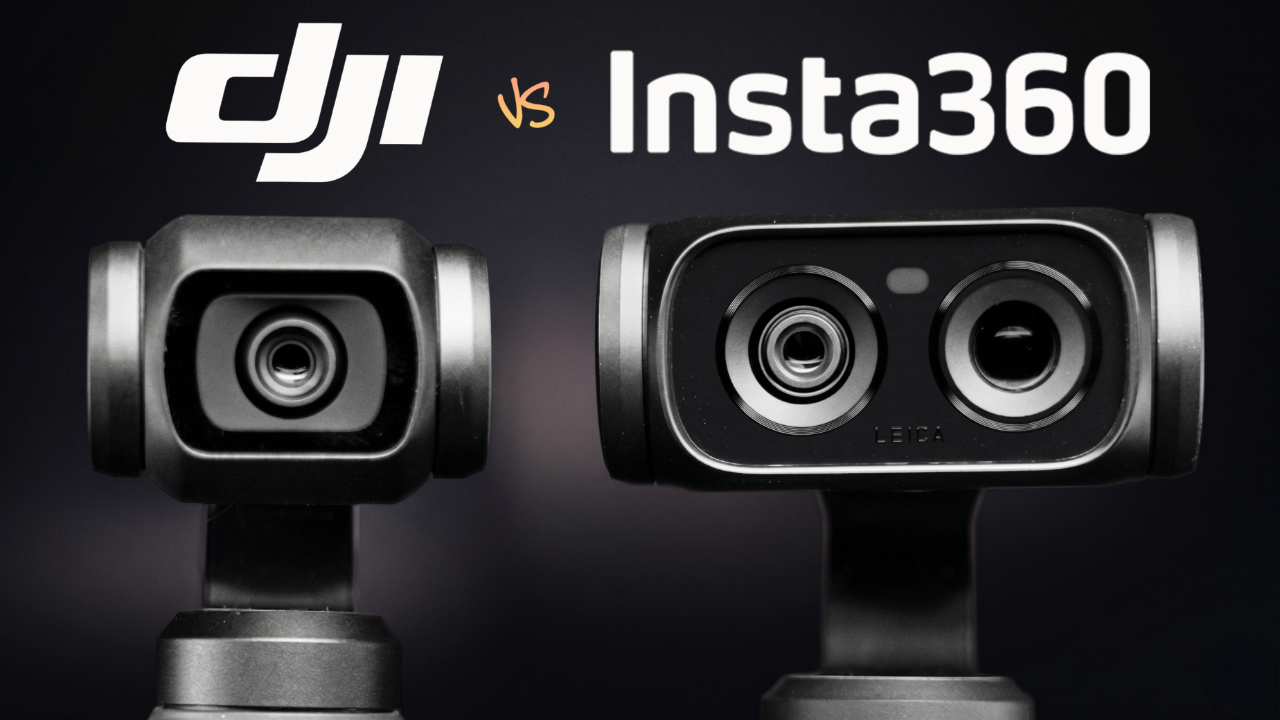
Insta360 Luna vs Osmo Pocket 4: Which Pocket Camera Is Actually Better?
Oct 28, 2026Get the full story watching the video above ⬆️
Purchase:
Insta360 Luna Ultra Course: https://geni.us/1DqW9
Insta360 Luna Ultra LUTs: https://geni.us/cueA7q7
Film Look for Insta360 Luna Ultra: https://geni.us/rdv6A
Osmo Pocket 4 Course: https://www.thefilmalliance.com/courses
Film Look for Osmo Pocket 4: https://geni.us/PBke6
Osmo Pocket 4 LUTs: https://geni.us/BCDH9
A lot of people thought the DJI Osmo Pocket 4 was going to be the pocket camera to beat. DJI has owned this category for a long time, and after the Osmo Pocket 3 became one of the most popular creator cameras on the market, it felt like the Pocket 4 was almost guaranteed to be the next obvious upgrade.
But then Insta360 dropped the Insta360 Luna, and all of a sudden, this comparison got a lot more interesting.
The Insta360 Luna and the DJI Osmo Pocket 4 are both trying to solve the same problem. They are both small pocket gimbal cameras designed for creators, travelers, vloggers, YouTubers, and everyday filmmakers who want smooth footage without carrying a bigger mirrorless camera setup. But even though they look like they belong in the same category, they approach filmmaking in two very different ways.
The Insta360 Luna is the more exciting camera on paper. It gives you 8K video, dual lenses, a real telephoto option, a detachable screen, and a lot of flexibility for creators who want more than just a simple point-and-shoot camera. The Osmo Pocket 4, on the other hand, feels more like the refined creator tool. It has a 1-inch sensor, strong stabilization, D-Log, excellent slow motion, and a more mature shooting experience.
So the real question is not just which camera has the better specs. The real question is which camera gives you the better image, which camera is easier to trust, and which one would I actually want to travel with?
After testing both cameras side by side, I can say this pretty clearly. I am happy I bought the Osmo Pocket 4, and for travel, I still think the Pocket 4 wins all day. But when it comes to pure image quality, 8K recording, flexibility, and having a real telephoto lens, I do think the Insta360 Luna is the better camera in several important ways.
Insta360 Luna vs Osmo Pocket 4: The Main Difference
The biggest difference between the Insta360 Luna and the Osmo Pocket 4 is how each camera is designed to be used.
The Insta360 Luna feels like Insta360 looked at the pocket camera market and said, “What features are creators still asking for?” The answer seems to be 8K video, a dual-lens system, better zoom, a detachable screen, and more creative flexibility. The Luna feels like a camera built for people who want more options in the smallest possible package.
The Osmo Pocket 4 feels like DJI took what worked on the Osmo Pocket 3 and made it more refined. It is not trying to be the flashiest camera in every category, at least not the standard Pocket 4, but it is trying to be reliable, portable, stabilized, and easy to use. It feels like a camera made for people who want to pull it out of a bag, turn it on, and get the shot without thinking too much.
That difference matters because these two cameras are not only separated by specs. They are separated by philosophy. The Luna is more ambitious. The Pocket 4 is more mature.
Image Quality: The Luna Surprised Me
When I first started comparing the Insta360 Luna vs Osmo Pocket 4, I was mostly interested in image quality. Both cameras are small, both are stabilized, and both are designed for the same type of creator, so the image is where the comparison really starts to matter.
And honestly, the Insta360 Luna surprised me.
In a lot of shots, the Luna gave me a cleaner, more flexible image. The midtones often felt slightly lifted, and I actually liked that because it helped keep the image from feeling too digital or overly crushed. The shot had a little more life to it, especially in situations where I wanted the image to feel natural but still polished.
The Osmo Pocket 4, on the other hand, sometimes gave me a more cinematic-looking image by not raising those midtones as much. The contrast felt a little more controlled, and depending on the lighting, the Pocket 4 could look more natural right out of camera.
But the thing I noticed quickly is that both cameras have very different color science. In some shots, the difference is obvious. The sky color, contrast, saturation, and skin tones can look very different between the Insta360 Luna and the Osmo Pocket 4, even when both cameras are exposed the same way.
This is one of the biggest things you need to know before buying either camera. These are not two cameras that look exactly the same. If you put them side by side, you will see differences in color. Sometimes the Luna looks better. Sometimes the Osmo Pocket 4 looks better. And sometimes it just comes down to personal preference.
Color Science: Two Very Different Looks
Color science is one of the most important parts of this comparison because the Insta360 Luna and Osmo Pocket 4 can produce very different images.
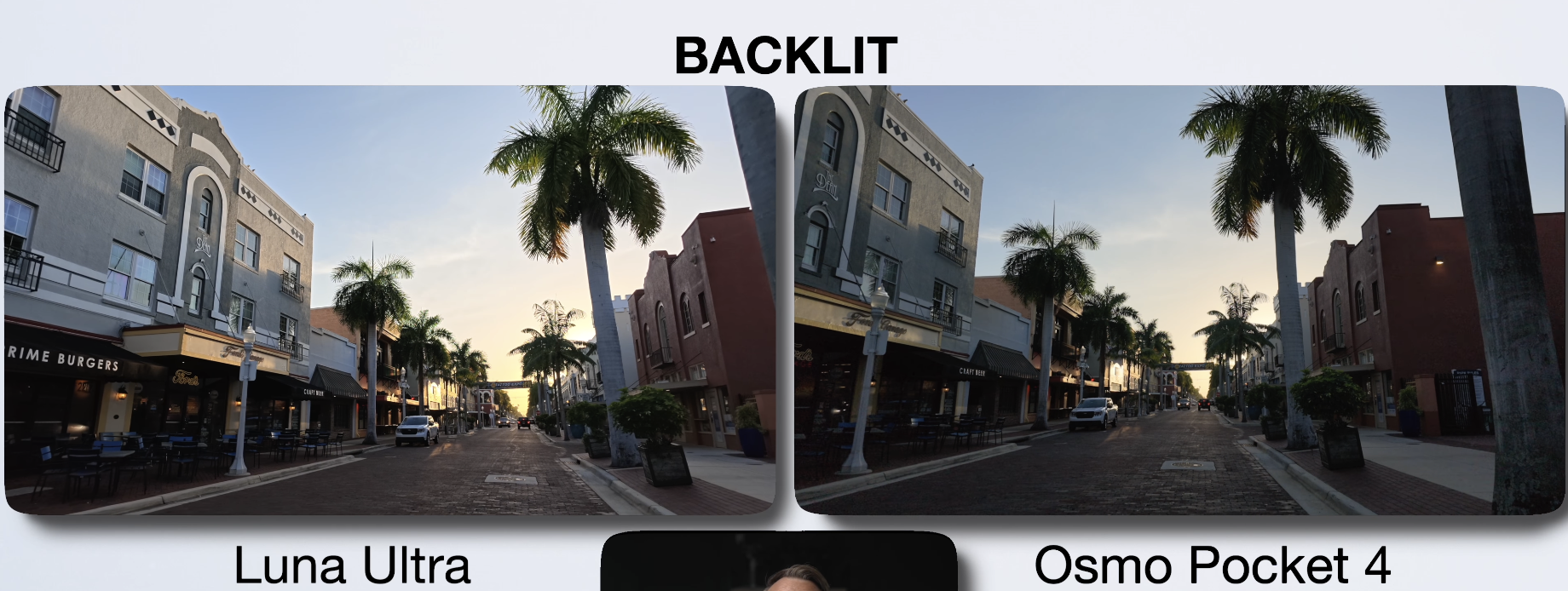
In controlled lighting, both cameras start to look a lot closer. If you are filming with the sun to your back, with good light hitting your subject, both cameras can produce vibrant colors, clean contrast, and a very usable image. This is where both cameras look their best.
But once you start shooting in trickier lighting, the differences become more noticeable.
In backlit scenes, both cameras handled the image well, but they did it differently. The Luna seemed to lift the midtones a little more, which gave the image a slightly more open look. The Pocket 4 held onto a darker, more contrasty look, which can feel a little more cinematic depending on the shot.
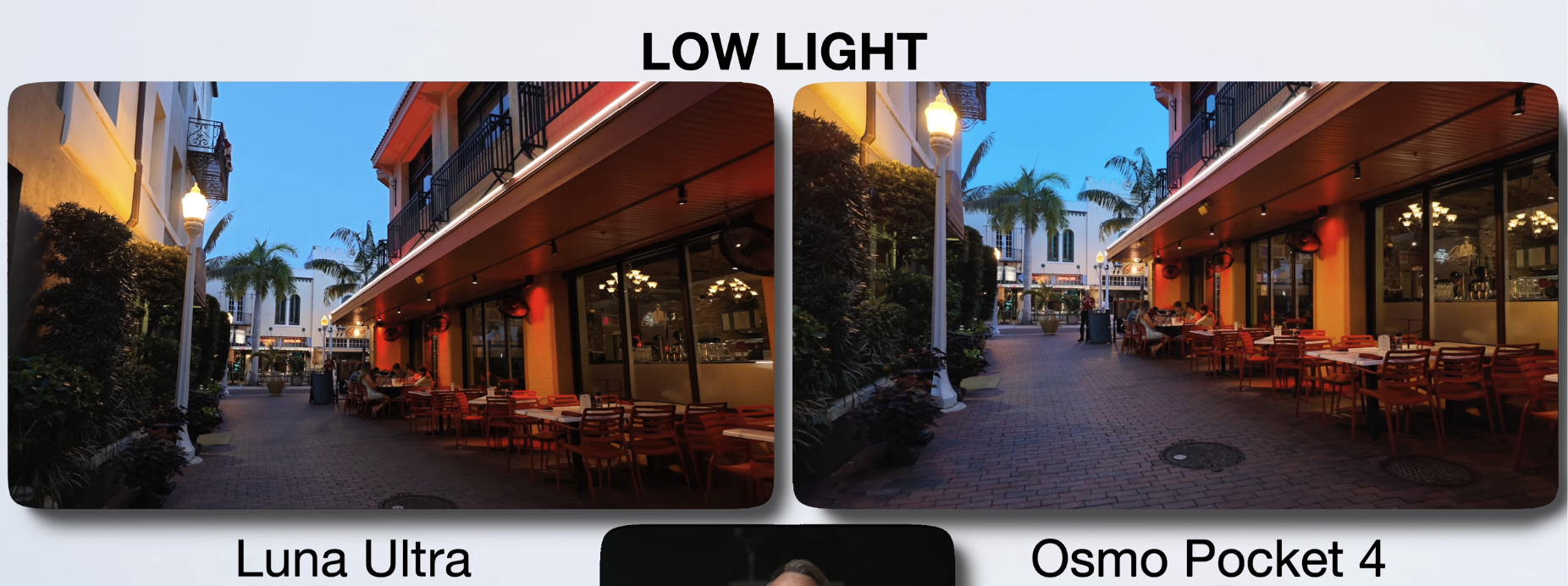
In low light, both cameras struggled with certain sky colors. I noticed greenish tones in the sky with the Insta360 Luna, and to be fair, the Osmo Pocket 4 did not always do much better. In some shots, the Pocket 4 looked even more green. That is important because low light is where small cameras can start to reveal their weaknesses, even when they have larger sensors.
If you are shooting in a clean lighting environment, both cameras can look great. But if you are filming in mixed lighting, night scenes, or scenes with difficult skies, you may notice more color shifts than you would expect.
Dynamic Range: Both Are Pretty Similar in Standard Profiles
When it comes to dynamic range, both the Insta360 Luna and the Osmo Pocket 4 are capable cameras, but neither one is magic.
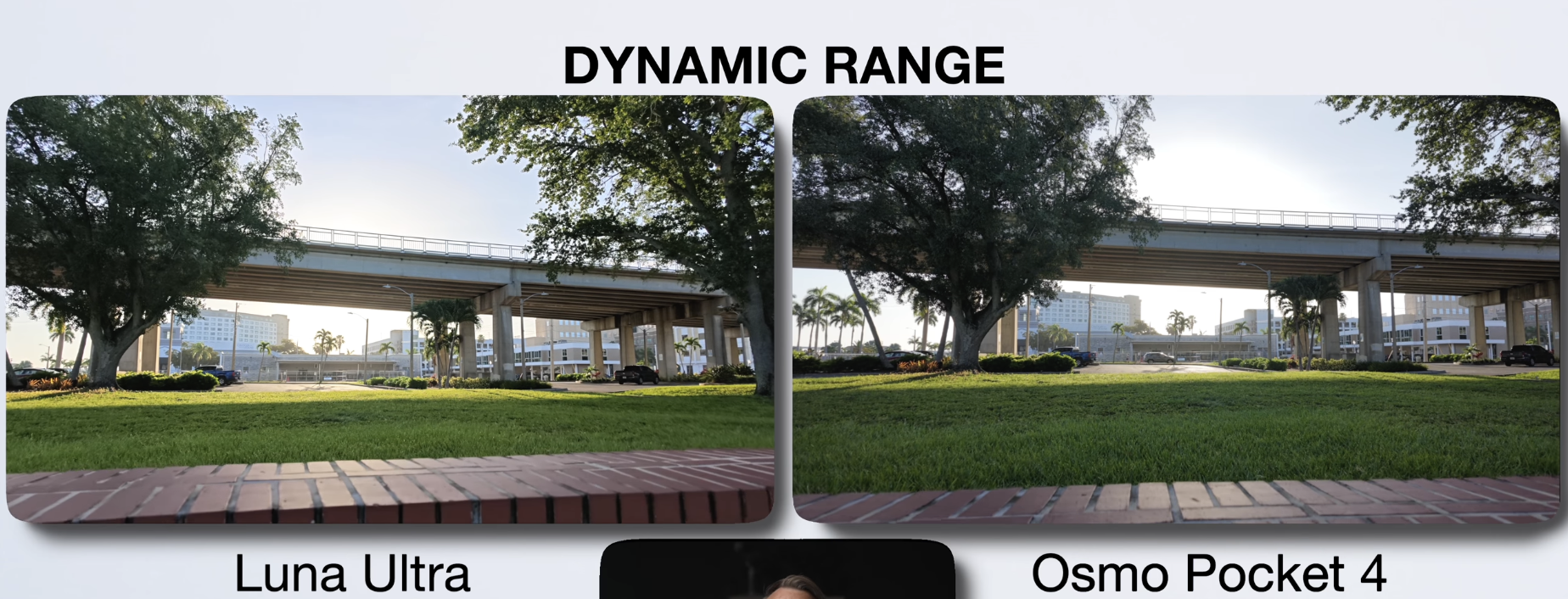
In the standard color profile, I found that both cameras performed pretty similarly. If you point either camera into a very bright sky, the sky can still blow out. You can retain a decent amount of shadow detail underneath bridges, buildings, or shaded areas, but you are not getting unlimited highlight recovery.
That is where Log profiles come in.
The Insta360 Luna gives you I-Log, and the Osmo Pocket 4 gives you D-Log. If you are someone who likes color grading, applying LUTs, or getting the most out of your footage in post-production, both cameras give you a lot more flexibility when shooting in Log.
I found that both Log profiles graded pretty well in post. Neither one felt impossible to work with, and both can look really good once you apply a proper conversion LUT or film look LUT. If you are a beginner, you can absolutely shoot in the standard color profile and get good results, but if you want the best image quality from either camera, Log is worth learning.
Normally, when I shoot in the standard color profile, I like to underexpose a little, around -0.7. But when shooting in Log, I usually prefer exposing closer to 0.0 because I want as much information as possible without crushing the image too much.
8K vs 4K: Why the Insta360 Luna Has a Real Advantage
One of the biggest advantages of the Insta360 Luna is 8K recording.
Now, I do not think everyone needs to export videos in 8K. Most people watching YouTube, Instagram, TikTok, or even client videos are still watching in 4K or lower. But the real benefit of 8K is not always the final export. The real benefit is reframing.
With 8K footage, you can crop in, punch in, create vertical clips, or reframe your shot later without the image falling apart as quickly. That is huge for solo creators, travel creators, and YouTubers who want flexibility in post-production.
The Osmo Pocket 4 does not have 8K, but it fights back with stronger slow motion. The Pocket 4 can shoot 4K up to 240 frames per second, which is a big deal if you shoot cinematic B-roll, water, product shots, action shots, or anything you want to slow down dramatically.
So this really depends on what you value more. If you want resolution and cropping flexibility, the Insta360 Luna has the advantage. If you want extreme slow motion in 4K, the Osmo Pocket 4 has the advantage.
For me personally, 8K and a real telephoto lens make the Luna feel more powerful creatively, but 4K 240fps on the Pocket 4 is still a really strong feature.
The Telephoto Lens Is a Big Deal
The telephoto lens is one of the biggest reasons I think the Insta360 Luna is better than the Osmo Pocket 4 for pure creative flexibility.
Most pocket cameras give you a wide lens and then rely on digital zoom. Digital zoom can be useful, but it does not look the same as having a real telephoto lens. With the Luna, you get a dedicated telephoto option that gives you a different look, more compression, and a cleaner punch-in.
This matters for travel videos, product shots, details, street filming, food, architecture, and anything where you want to isolate a subject without physically moving closer.
The Osmo Pocket 4 does have zoom options, and the image can still look good, but it is not the same as having a true telephoto lens. This is probably one of the biggest reasons I would say the Luna feels more versatile.
A wide lens is great for vlogging and walking shots. But a telephoto lens gives you variety. It gives you detail shots. It gives you compression. It makes the video feel less like everything was shot on one tiny wide-angle camera.
That is a big win for the Insta360 Luna.
Stabilization: The Osmo Pocket 4 Still Feels More Trustworthy
Both cameras use mechanical stabilization, and both cameras can produce smooth footage. But if I had to choose one camera for walking around, traveling, or filming quickly, I would still choose the Osmo Pocket 4.
DJI has been doing pocket gimbal cameras for a long time, and you can feel that maturity in the Pocket 4. It feels reliable. It feels simple. It feels like a camera I can trust when I am walking, filming family, traveling, or trying to get a shot quickly.
The Insta360 Luna is very impressive, but because it is doing more with the dual lenses, 8K, and detachable screen, it feels like there is more going on. That is not always a bad thing, but it can make the camera feel a little less simple.
This is why I still think the Osmo Pocket 4 wins for travel. When I travel, I do not always want the most complicated camera. I want the camera that is easiest to use, easiest to carry, and easiest to trust.
The Luna may give me better image quality in some situations, but the Pocket 4 is the camera I would rather have in my pocket when I just need to get the shot.
Low Light Performance: Neither Camera Is Perfect
Both the Insta360 Luna and the Osmo Pocket 4 are impressive for their size, but low light is still a challenge.
These cameras have small bodies, tiny lenses compared to mirrorless cameras, and limited room for heat management and processing. Even with a 1-inch sensor, you still need to be realistic.
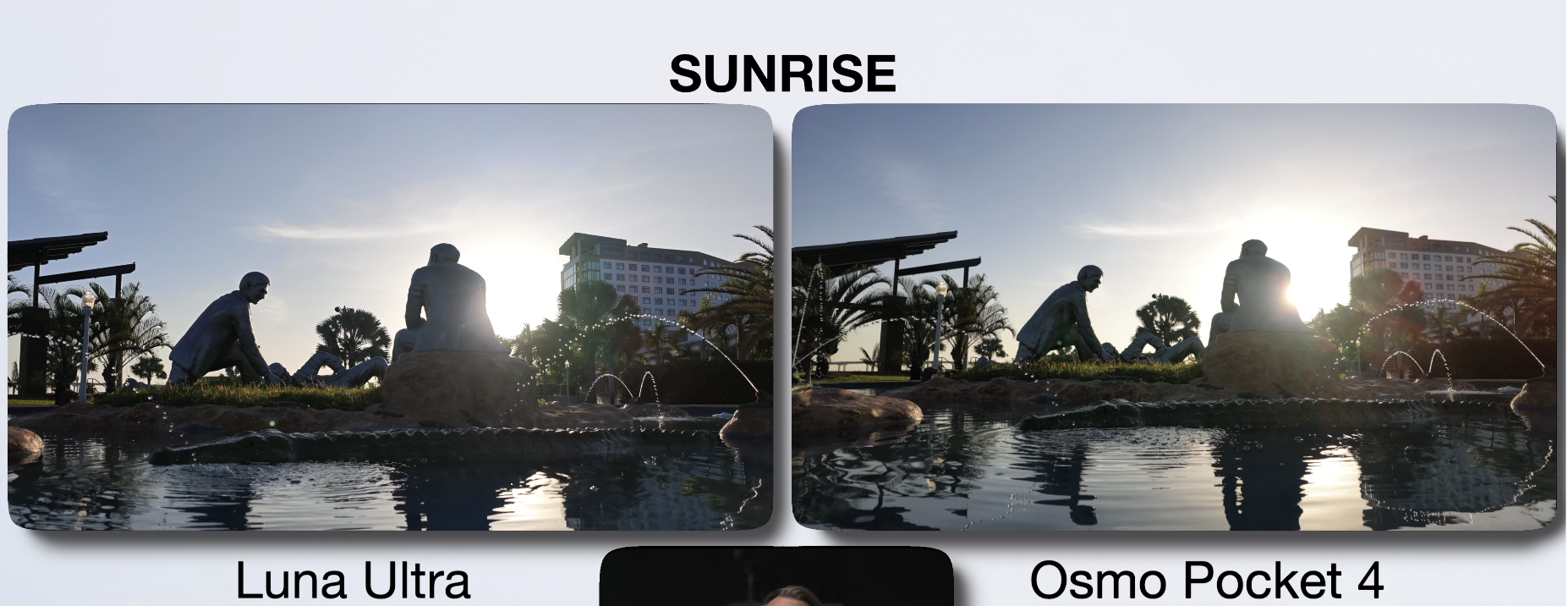
In my tests, both cameras could look good in low light when there was enough usable light in the scene. If there were storefronts, street lights, signs, or a sunset still giving the camera something to work with, both cameras performed pretty well.
But in darker scenes, especially when filming the sky, both cameras could shift in ways I did not love. The sky could take on a greenish color, and once you notice it, it is hard to unsee.
For silhouette shots or blue-hour scenes with some light still in the sky, both cameras looked much better. So my general advice would be this: if you are filming at night, look for light. Do not expect either camera to turn a bad lighting environment into a cinematic shot automatically.
Audio: DJI Still Has the Edge
Audio is one of those things people forget about until they actually start using the camera.
The Insta360 Luna has interesting audio features, especially with the detachable screen and its ability to work as a wireless mic-style solution. That is a very cool idea, and for solo creators, it could be a really useful feature.
But DJI’s microphone ecosystem is still one of the big advantages of the Osmo Pocket 4. DJI has a more mature system, and the Pocket cameras have worked really well with DJI mics. For creators who care about simple wireless audio, reliable connection, and better noise reduction, the Osmo Pocket 4 still has a strong advantage.
If you are mainly filming travel B-roll, image quality might matter more. But if you are filming vlogs, talking head clips, family videos, or YouTube content where you are speaking to the camera, audio is a huge part of the decision.
Travel Camera: Osmo Pocket 4 Wins
This is where I think the Osmo Pocket 4 really makes sense.
If I were traveling, I would pick the Pocket 4 all day. It is compact, stabilized, easy to carry, and easy to use. It feels like the kind of camera I can throw in a bag and not overthink.
The Insta360 Luna is more powerful in some ways, but the Osmo Pocket 4 feels more practical. When you are walking around a city, filming your family, shooting quick travel clips, or trying to document a trip, the easiest camera often becomes the best camera.
The Pocket 4 is also less intimidating. It feels like a camera that gets out of your way. That matters more than people think.
The Luna gives you more creative tools. The Pocket 4 gives you less friction.
For travel, I would take less friction.
Which Camera Is Better for YouTube?
If you are buying a camera specifically for YouTube, the answer depends on your style of content.
If you make travel videos, family videos, casual vlogs, walking videos, or quick creator content, the Osmo Pocket 4 is probably the safer choice. It is simple, stabilized, and easy to use.
If you make more polished videos, product shots, cinematic B-roll, travel films, or content where you want different focal lengths and more flexibility in post, the Insta360 Luna might be the better choice.
The 8K footage and telephoto lens make the Luna more flexible for editing. You can get wide shots, tighter shots, detail shots, and more variety without switching cameras. That makes a big difference when you want your video to feel more professional.
But if you value speed and simplicity, the Pocket 4 is hard to beat.
Should You Buy the Insta360 Luna or Osmo Pocket 4?
If you want the best image quality, the most flexibility, 8K recording, and a real telephoto lens, I would lean toward the Insta360 Luna. It is the more exciting camera, and in a lot of ways, it feels like the camera pushing this category forward.
If you want the best travel camera, the easiest shooting experience, strong stabilization, good color, and a camera you can rely on without thinking too much, I would lean toward the Osmo Pocket 4.
That is really the difference.
The Insta360 Luna is the camera I would choose when I want the most creative flexibility.
The Osmo Pocket 4 is the camera I would choose when I want to travel light and trust the shot.
Final Verdict: Insta360 Luna vs Osmo Pocket 4
After shooting with both of these cameras, I am still really happy that I picked up the Osmo Pocket 4. It is small, reliable, stabilized, and for traveling, walking around, filming family, or grabbing quick shots, I think the Pocket 4 wins all day.
But if I am being totally honest, when it comes to pure image quality, 8K recording, flexibility, and having that real telephoto lens, I do think the Insta360 Luna is the better camera in a lot of ways.
The Luna gives you more options. That telephoto lens makes a bigger difference than I thought it would, and 8K gives you more room to crop, reframe, and create different versions of the same shot. It is not perfect, and I still think the Pocket 4 is easier to trust as a travel camera, but the Luna is a serious competitor.
So for me, the Osmo Pocket 4 is the camera I would rather travel with, but the Insta360 Luna is probably the camera I would choose if I wanted the best-looking footage and the most creative flexibility.
And that is what makes this comparison so interesting. The Osmo Pocket 4 may still be the safer camera, but the Insta360 Luna might be the more exciting one.
Author

