
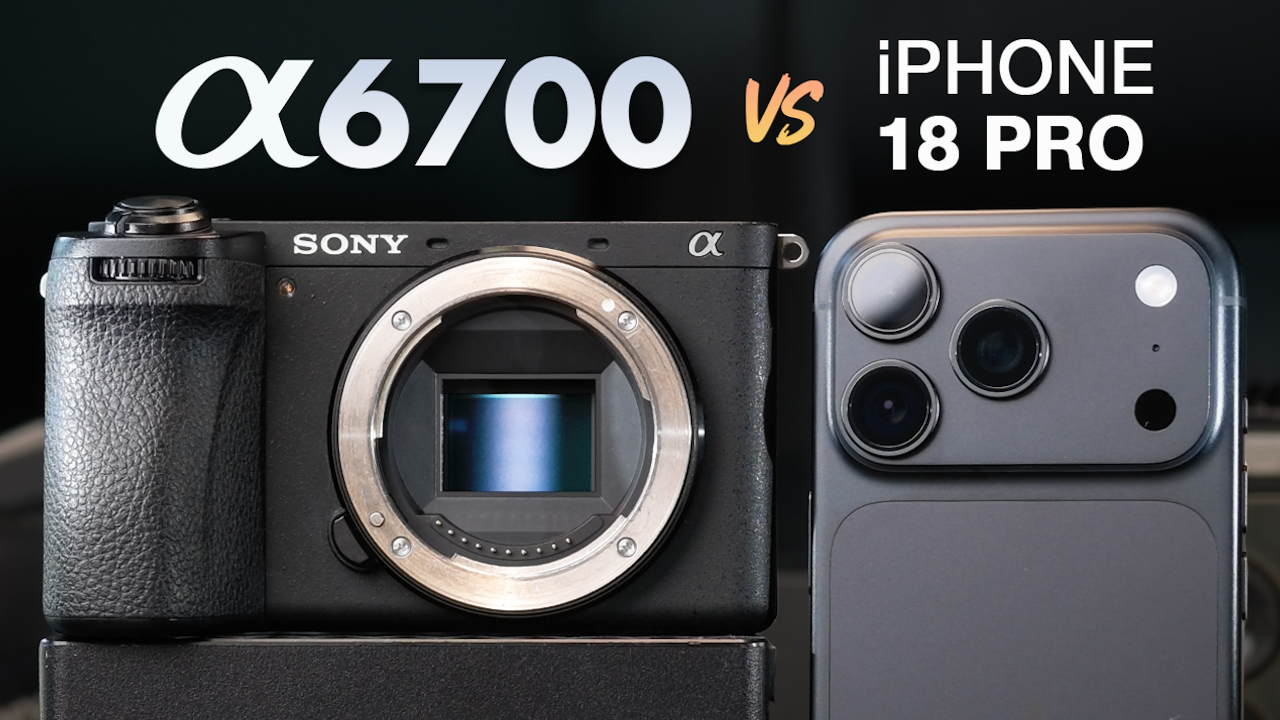
iPhone 18 Pro vs Sony a6700: Which Camera Should You Actually Use?
Oct 22, 2026Get the full story watching the video above ⬆️
Can a phone really replace your camera?
The Sony a6700 beats the iPhone 18 Pro on image quality, control and creative potential, but the iPhone wins on portability. That's the short answer after shooting both side by side for my latest comparison.
I'm Joel with The Film Alliance, and I get this question constantly. Phones keep getting better, so is a dedicated mirrorless camera still worth carrying around? I didn't want to just compare colors and pixels. I wanted to look at how each one actually fits into a real shooting day.
If you're a content creator, a filmmaker on a budget or just someone deciding where to put your money, this breakdown is for you.
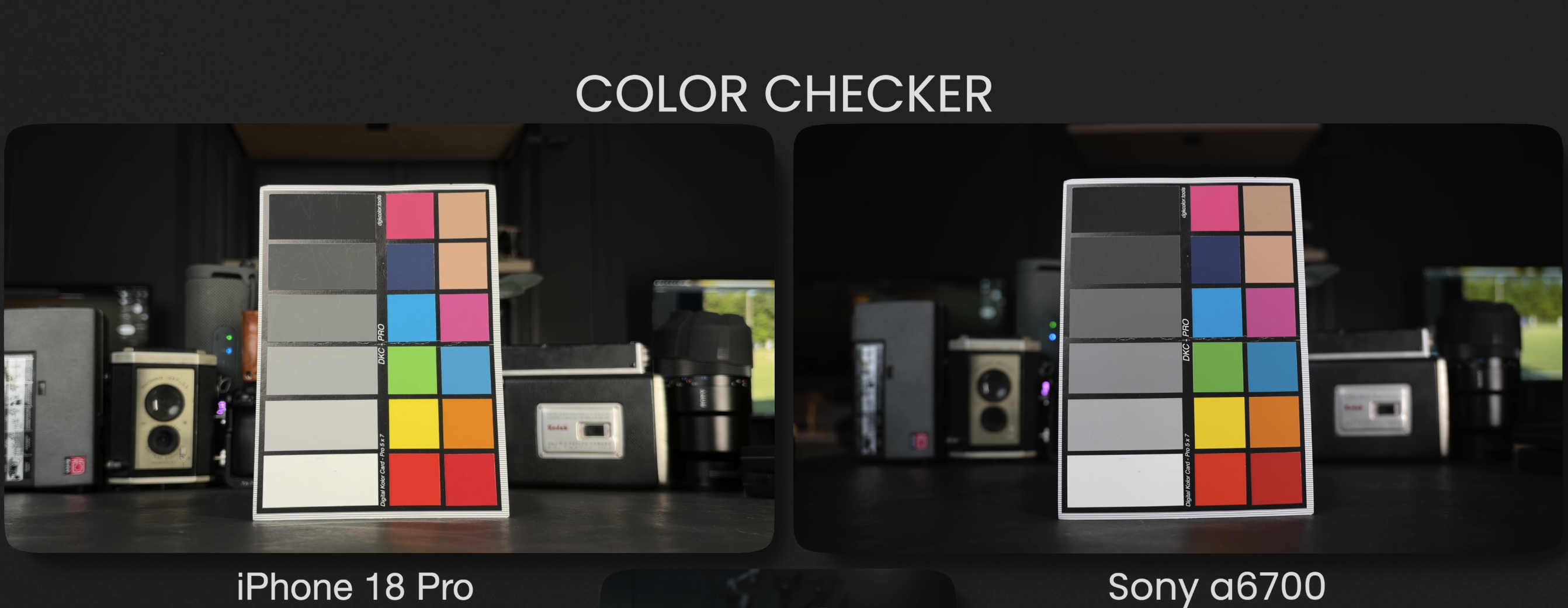
Image quality: sensor size still matters
The a6700 gives me better image quality, and most of that comes down to its much larger 26MP APS-C sensor. The iPhone 18 Pro has more megapixels on paper, but megapixels aren't the whole story.
|
Spec |
iPhone 18 Pro |
Sony a6700 |
|
Main sensor |
48MP Fusion Main camera |
26MP APS-C sensor |
|
Aperture |
Variable, f/1.48 to f/4 |
Depends on your lens |
|
Screen |
Built-in display |
3" fully articulating touchscreen |
|
Viewfinder |
None |
Electronic viewfinder |
|
Starting price |
$1,199 |
$1,399.99 body only (launch price) |
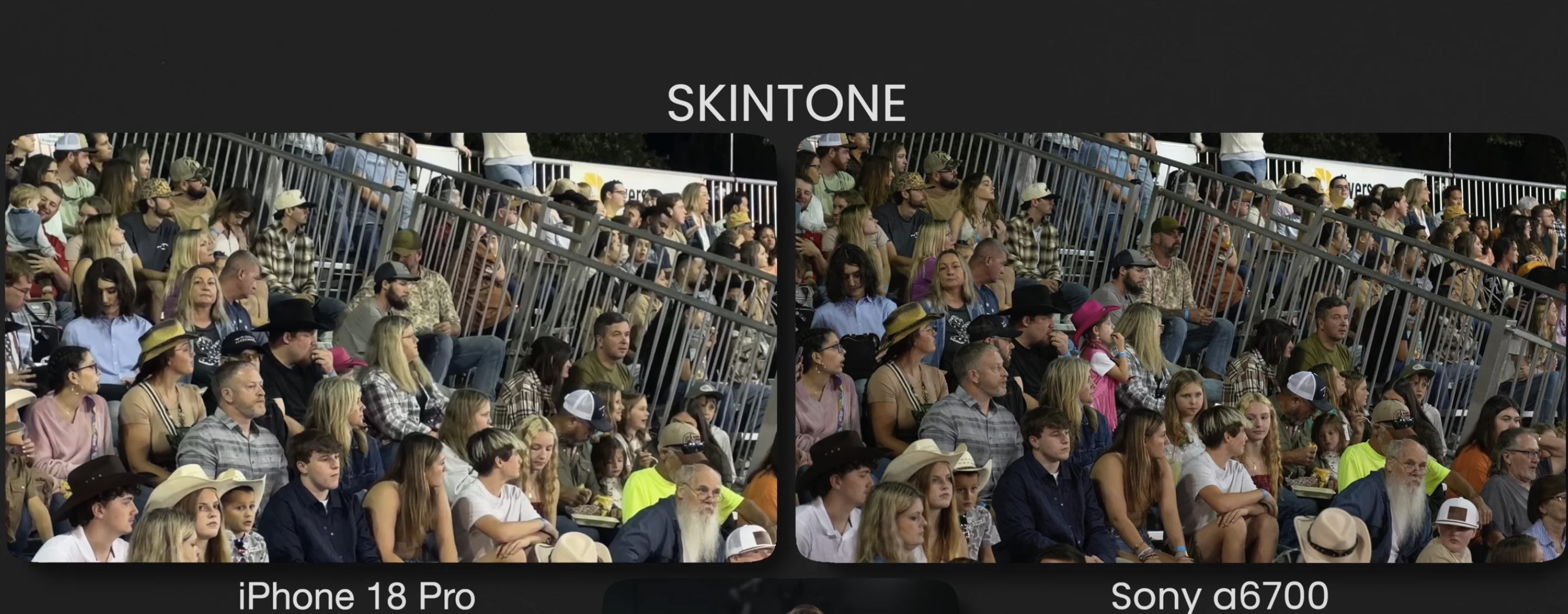
Where I notice the difference most is skin tones. The iPhone tends to push saturation and lift the midtones, which can make skin look a little processed. The a6700 gives me more true-to-life skin tones straight out of camera, often without even setting a custom white balance.
In bright, even light though, like a sunrise or a landscape on a clear day, the gap almost disappears. The iPhone's processing does a great job when there's plenty of light to work with.
Low light: where the a6700 pulls ahead
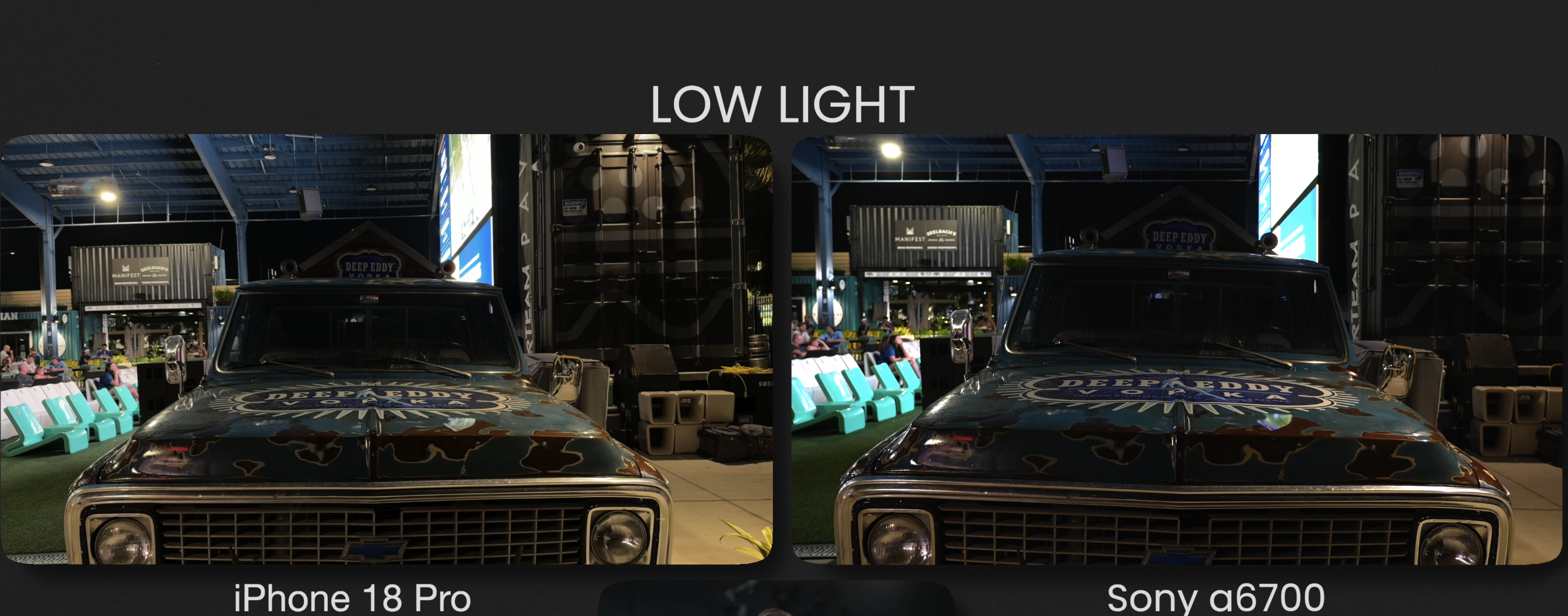
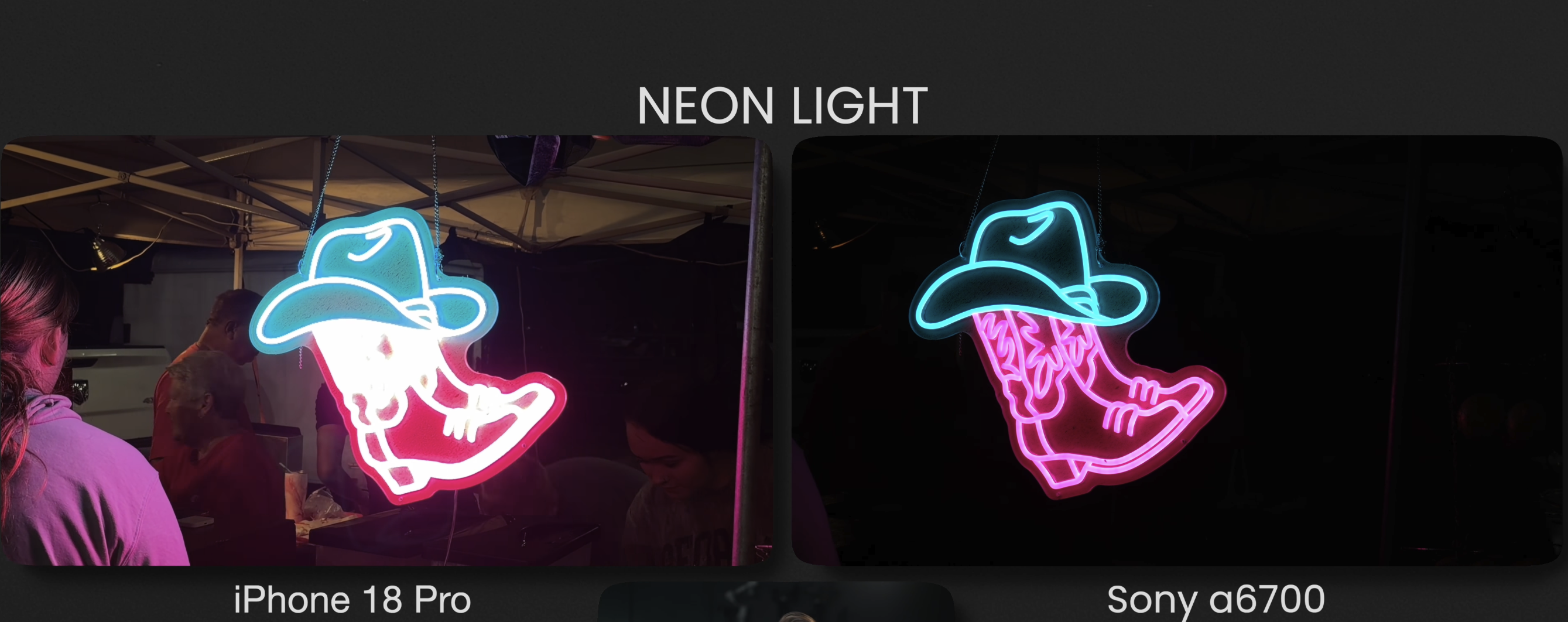
Low light is where the a6700 really earns its place in my bag. That bigger sensor gathers more light, so my night footage comes out cleaner with less noise.
The a6700's native ISO range runs from 100 to 32,000, and for video it has two native ISO points at 800 and 2500 where noise stays especially low. Pair it with a fast lens like the Sigma 18-50mm f/2.8 and it handles dark scenes with ease.
To be fair, the iPhone 18 Pro is better in low light than any phone I've used. Its main camera can open up to f/1.48 to pull in more light. But a few things still show up when the sun goes down:
- Yellow color shift: in low light, the iPhone tends to push everything a little yellow, especially screens and signs.
- Backlit scenes: when a bright light sits behind your subject, the iPhone's midtones go wild and the whole shot looks flat.
- Lifted shadows: the iPhone's processing brightens dark areas, even when I've turned exposure down on purpose.
For general night shots with mixed lighting, though, the iPhone does a really good job. Underexpose it a touch and it picks up a lot of color and texture in the light.
Control: exposure and focus
For anything I'm setting up on purpose, like product shots or green screen, I reach for the a6700 because I'm in complete control.
Apple closed the gap a lot this year. The iPhone 18 Pro's camera app now has Pro controls for aperture, shutter speed and white balance, plus a histogram. For deeper video control I still lean on apps like Blackmagic Camera or Final Cut Camera.
With the a6700, everything lives right on the body:
- Manual exposure with physical dials, plus monitoring tools like zebras and a histogram
- Manual focus with focus peaking, so I can tell when a product label is tack sharp
- Interchangeable lenses, so I'm never stuck with whatever the phone's three cameras give me
Both cameras handle autofocus tracking well. On the iPhone, I tap the display and it follows my subject. The a6700 does the same with one tap, and its eye tracking keeps people locked in as they move.
Portability: the iPhone's biggest advantage
The iPhone 18 Pro wins on portability, and in real life that matters more than most spec sheets admit. It's already in my pocket, so I never miss a moment because my camera was at home.
It also changes how people react to you. Hold up a phone in a crowd and nobody thinks twice. Set up the a6700 on a tripod in the same spot and people start staring, wondering what you're filming.
For street shooting, events or anywhere you want to blend in, that freedom can be worth more than slightly better skin tones. The a6700 is compact for a mirrorless camera at 493g body only, but it's still a camera you have to decide to bring.
Everyday usability: time lapse, slow motion and screens
Each camera wins different everyday tasks, so here's how they split for me.
- Time lapse: the iPhone wins on ease of use. It has a dedicated time-lapse mode that now records in 4K and Dolby Vision HDR. The a6700 can do it in camera with S&Q mode, but it takes a minute to set up.
- 4K 120fps slow motion: both shoot it, and I was shocked how good the iPhone looked. Side by side, though, the a6700 shows noticeably more detail.
- Photos: the iPhone does a great job, but switch it to 48MP, because it shoots at 24MP out of the box.
- Viewfinder: the a6700's electronic viewfinder lets me frame shots in bright sun when a phone screen washes out.
- Low angles: holding a phone down low in bright light, I can barely see the display. The a6700's fully articulating screen flips out so I can see exactly what I'm framing.
Price: what you'll really spend
Once you add a few lenses, the a6700 setup runs about double what the iPhone 18 Pro costs. The iPhone starts at $1,199, and the a6700 body alone launched at $1,399.99 before any glass.
That's why I don't think of this as either/or. These two make a great A cam, B cam setup. The a6700 handles the main angle and anything I want full control over. The iPhone grabs a second angle, behind-the-scenes clips and the moments I'd otherwise miss.
My verdict: iPhone 18 Pro or Sony a6700?
If you want more control, better image quality and more creative potential, get the Sony a6700. If portability and convenience matter most, the iPhone 18 Pro is the smarter buy.
- Choose the a6700 if you shoot low light, product work, client projects or anything where skin tones and detail really matter, and you want to grow as a filmmaker.
- Choose the iPhone 18 Pro if you want one device that's always with you, you shoot in public a lot, or you mostly post to social media.
- Choose both if your budget allows. They're a fantastic A cam, B cam pairing.
Frequently asked questions
Is the iPhone 18 Pro better than the Sony a6700?
Not for image quality. The a6700's larger APS-C sensor gives better low-light performance, skin tones and detail. The iPhone 18 Pro wins on portability and ease of use.
Is the Sony a6700 good for low light?
Yes. Its 26MP APS-C sensor and native ISO range up to 32,000 handle dark scenes well, especially with a fast lens like the Sigma 18-50mm f/2.8.
Can the iPhone 18 Pro replace a mirrorless camera?
For social media, travel and casual shooting, it gets very close. For low light, product work and full creative control, a mirrorless camera like the a6700 still has a clear edge.
Does the iPhone 18 Pro have manual controls?
Yes. The iPhone 18 Pro's camera app has Pro controls for aperture, shutter speed and white balance, plus a histogram.
Is the Sony a6700 worth it in 2026?
If you want to grow as a filmmaker or photographer, yes. Interchangeable lenses, full manual control and a larger sensor give you room to improve that a phone can't match.
Take your talking heads further
Whichever camera you pick, the way you light and mic yourself matters just as much as the gear. That's why I built my talking head course. It will elevate the way your talking heads look, from lighting to audio, no matter what camera you own.
Thanks for reading, and I'll see you in the next one.
Author

